

GD32F103TBU6: Technical Specs Summary & Benchmarks
High-performance 108 MHz ARM Cortex-M3 microcontroller optimized for cost-sensitive embedded control and deterministic performance.
The GD32F103TBU6 is a 108 MHz ARM Cortex-M3 microcontroller featuring 128 KB of flash and 20 KB of SRAM. It is strategically positioned for applications where single-core deterministic performance is paramount. This guide provides technical specifications, reproducible benchmarks, and a hands-on evaluation checklist to streamline your prototype validation and design trade-offs.
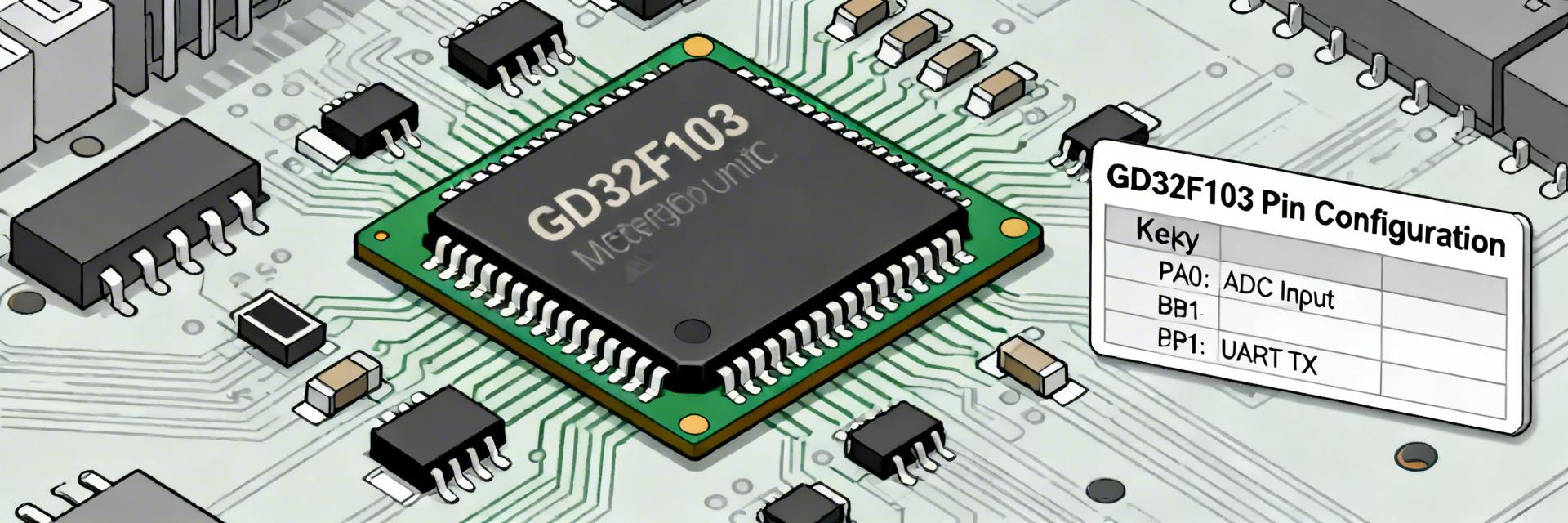
Technical Specifications Overview
| Attribute | Value |
|---|---|
| CPU Core / Max Clock | ARM Cortex-M3, 108 MHz |
| Flash Memory | 128 KB |
| SRAM | 20 KB |
| Package | QFN-36 (Thermal Pad) |
| Voltage Range | 2.6 V – 3.6 V (Typical) |
| I/O Count | ~37 Usable GPIO |
| Key Peripherals | USART, SPI, I2C, 12-bit ADC, Timers, USB FS |
Design Insight: Designers should size firmware and RAM buffers carefully to fit within the 128KB/20KB limits, reserving sufficient flash for bootloaders and OTA (Over-the-Air) updates if required.
Benchmarks & Performance Analysis
CPU Performance (CoreMark)
Measured with -O3 optimization, interrupts disabled. Results may vary by toolchain.
Efficiency (DMIPS/MHz)
Approximate value based on Cortex-M3 architecture and optimized libraries.
In-Depth Technical Breakdown
Core, Clocks & Memory
The Cortex-M3 pipeline and flash access control determine execution speed. Use zero-wait code regions in SRAM for critical loops. Configure PLL for 108 MHz with optimized flash wait states to minimize latency.
Peripherals & I/O
Multiple timers and a 12-bit ADC supported by DMA channels allow for efficient data handling. Prefer ADC+DMA for continuous sampling to offload the CPU for complex processing tasks.
Evaluation & Integration FAQ
How do I ensure repeatable hardware benchmarks? +
What are the key real-time control considerations? +
When should I choose the GD32F103TBU6 over other models? +
Prototype-to-Production Checklist
- ✓ Power Integrity: Verify power-supply margins and decoupling capacitor placement close to VDD pins.
- ✓ Clock Validation: Confirm PLL stability and flash wait-state configuration for 108 MHz operation.
- ✓ Thermal Management: Ensure the QFN-36 thermal pad is correctly soldered to a large ground plane.
- ✓ Firmware Strategy: Implement a robust bootloader/DFU strategy and perform long-term peripheral soak tests.
