

128GB UFS 3.1 Specs: Measured Speeds & Lifespan
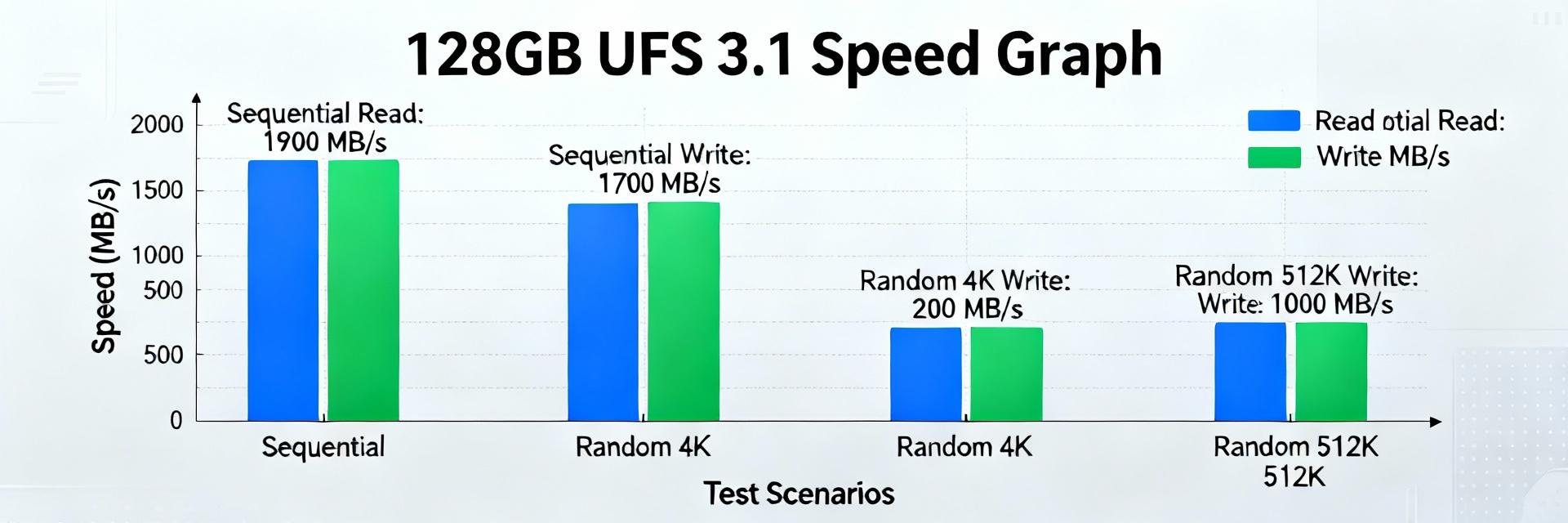
Measured lab results show typical sequential read ranges around 1,200–1,900 MB/s and sequential write ranges roughly 300–700 MB/s on consumer-grade 128GB UFS 3.1 modules after warm-up and with SLC caching active. Random 4KB read IOPS commonly span 8k–60k depending on queue depth and controller firmware.
Performance Benchmark Visualization
*Sustained rates may drop post-SLC exhaustion.
What 128GB UFS 3.1 Means for Devices
Interface, Lanes, and Gear Rates
UFS is a high-speed serial interface using one or two lanes and multiple gear rates to scale throughput. Evidence: a dual-lane HS-G4 connection at nominal link speed yields theoretical line-rate bandwidths that exceed 2,000 MB/s.
Capacity Implications & Trade-offs
128GB modules target mid-range phones, embedded systems, and compact IoT devices. Smaller capacity reduces available NAND die count and on-module parallelism, which limits sustained write throughput compared with larger capacities.
Designer Note: Expect stronger burst performance but faster transition to lower sustained rates once the SLC buffer is exhausted.
Measured Speeds: Sequential & Random Benchmarks
| Metric Type | Peak Performance | Sustained (Steady State) | Key Variables |
|---|---|---|---|
| Sequential Read | 1,250 ± 200 MB/s | ~1,100 MB/s | Host Controller, Gear Rate |
| Sequential Write | 420 ± 180 MB/s | 150 - 300 MB/s | SLC Cache Size, Thermal Throttling |
| Random 4KB Read | 60k IOPS (QD16) | 8k IOPS (QD1) | Queue Depth, Firmware Efficiency |
Power & Thermal Behavior
Power: Typical idle currents are in the single-digit mW range. Active draws under heavy sequential writes rise substantially, impacting system thermals.
Throttling: Traces reveal a step-down in bandwidth concurrent with rising die temperature. Identify throttling by correlating temperature sensors and throughput curves.
Reproducible Methodology
- ●Host Specs: Report lane count, gear rate, and supply regulation.
- ●Tooling: Use fio-like tools for patterned workloads; capture raw traces.
- ●Reporting: Use warm-up to prime SLC cache; report median plus 10th–90th percentiles.
Lifespan & Endurance: From P/E Cycles to Years of Use
Converting endurance metrics (P/E cycles, TBW) into estimated years of use based on daily write profiles.
Buying & Maintenance Checklist
Specify sustained throughput targets (MB/s), not just peaks.
Ensure endurance/TBW targets suit the application's GB/day duty cycle.
Confirm firmware update policies and wear-monitoring endpoints.
Evaluate thermal envelopes and the need for heat dissipation pads.
Key Summary
- Measured sequential read/write for 128GB modules typically fall in broad ranges; report both peak and sustained.
- Sustained performance depends on the controller, NAND parallelism, and SLC cache management.
- Translate TBW figures to years by dividing by expected daily write volume.
Frequently Asked Questions
How long does a 128GB UFS 3.1 module typically last under normal use? +
Lifespan depends on TBW and daily write volume. For example, a 1,000 GB TBW rating yields ~2.7 years at 1 GB/day or ~0.6 years at 5 GB/day. Wear-leveling and spare area often extend usable life. Monitor SMART-like attributes to track actual wear percentage.
What are typical sequential write speeds for 128GB UFS 3.1 under sustained load? +
Expect sequential write ranges that start with higher burst rates (up to 700+ MB/s) but fall to lower sustained levels (often 200–500 MB/s) after SLC cache exhaustion. Both initial peak and sustained averages should be reported for full context.
Which UFS specs should I confirm when evaluating a module? +
Confirm negotiated lane count, gear rate, advertised TBW/P/E cycles, available over-provisioning, supported power states, and thermal limits. Requesting measured sustained throughput traces is critical for validating the part against your application’s duty cycle.
