

Entry-level Cortex-M3 parts commonly hit 72 MHz with zero-wait flash and sub-mA sleep currents—but real-world results vary by silicon and board design. This analysis translates technical specifications into actionable engineering insights for reliable firmware-level decisions.
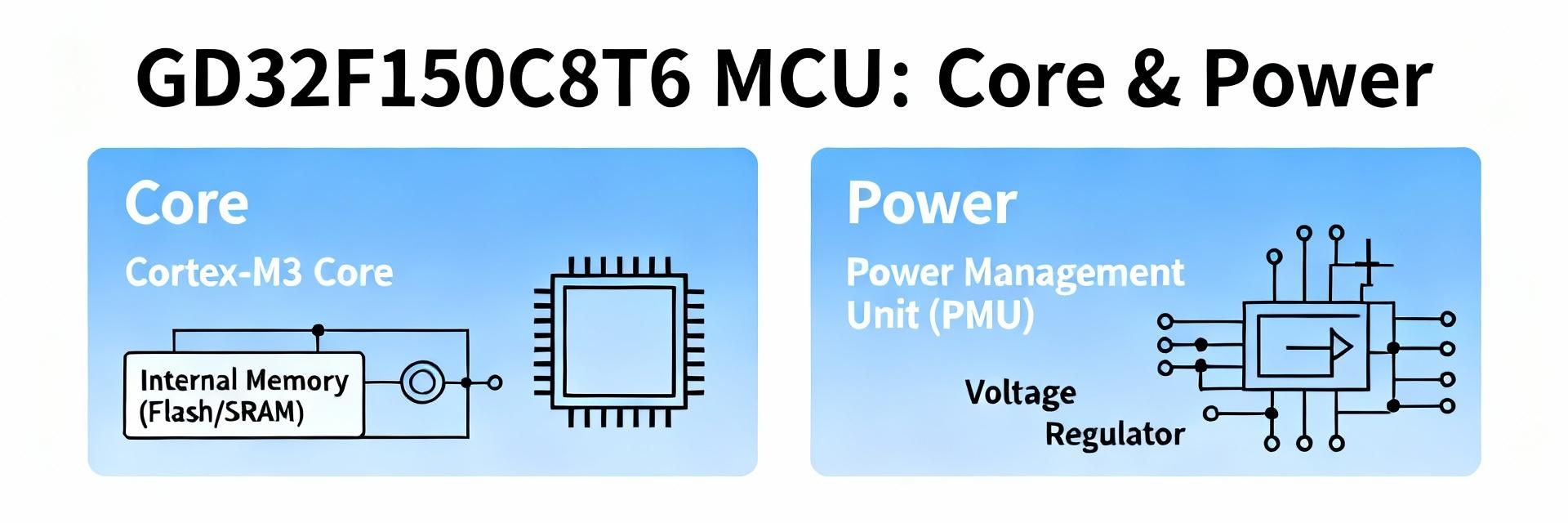
Product Positioning & Quick Spec Snapshot
The GD32F150C8T6 targets cost-sensitive, general-purpose embedded applications needing a Cortex‑M3 core with up to 72 MHz, modest on‑chip flash and SRAM, and a balanced peripheral set including ADCs and serial interfaces. Compact packages and low-cost BOM make it suitable for sensor hubs, simple motor controllers, and USB-capable devices when constrained by budget and board area.
Electrical & Memory Deep-Dive
Power & Thermal
The datasheet lists a VDD operating window and explicit decoupling recommendations. Typical active currents are baselines; "max" numbers are for worst-case thermal budgeting. Avoid measuring with debug probes attached as they inflate reported current.
Flash & Boot
Flash organization dictates code layout and OTA strategy. Wait-state tables show how access timing constrains clock frequency. Boot modes (system memory, user flash, or SRAM) must be validated for resume timing.
Peripherals & PCB Considerations
- > GPIO & Timers: Balance UART/SPI/I2C counts against debug needs to avoid multiplexing contention.
- > ADC Performance: Map ADC channels to effective resolution requirements at specific sampling rates.
- > Layout Guidance: Place 0.1 μF decoupling caps near VDD pins and a 10 μF bulk cap on the regulator.
Benchmarks & Performance Visualization
CoreMark performance scaling across target clock frequencies (72 MHz max):
Design & Integration Best Practices
Clocking & Stability
Choose crystals based on jitter needs; PLL tradeoffs include lock time. For USB timing, use a low-jitter crystal and validate RTC accuracy against a reference.
Reliability
Use atomic update strategies to avoid bricking. Enable the hardware watchdog and store a validated fallback bootloader in protected flash sectors.
