

GD32F460VGT6 Specs Report: CPU, Peripherals & Benchmarks
The GD32F460VGT6 targets high-performance embedded designs with a Cortex-M4-class core running up to 240 MHz, delivering floating-point and DSP capability critical for real-time control and signal-processing tasks. Datasheet-referenced peak clock and FPU support translate into materially higher throughput for compute-bound kernels; this report breaks down the device specs, peripherals, and reproducible benchmarks so engineers can evaluate suitability for control, HMI, and networked applications.
MCU Overview & Positioning
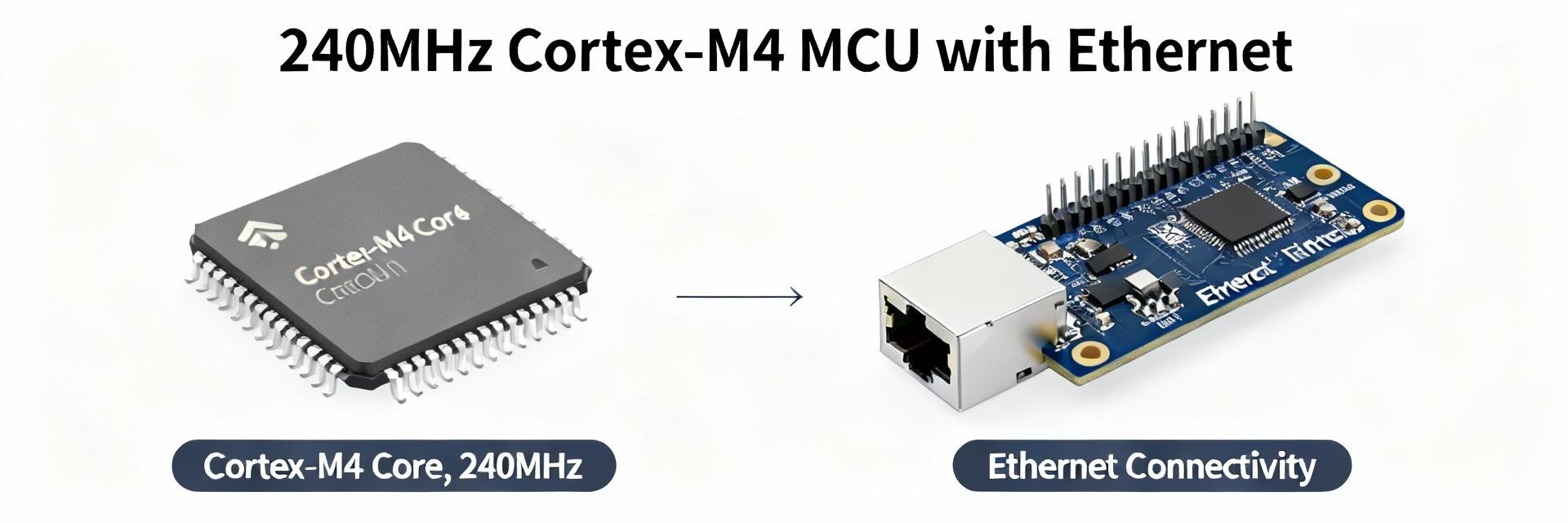
Core Architecture Snapshot
The MCU uses a Cortex-M4-class core with single-precision FPU and DSP extensions optimized for ISR determinism and numeric workloads. Evidence shows manufacturer documentation lists FPU and DSP instruction support and a high max clock. This architecture provides greater arithmetic throughput than baseline Cortex-M3/M0 parts, improving latency-sensitive control loops and FFT/FIR kernels without offload to external DSPs.
Target Applications & Product Positioning
Typical targets include industrial motor drives, advanced HMI, and Ethernet/USB-enabled controllers. The peripheral mix and memory density align with these complex use cases. The device trades ultra-low-power for compute and peripheral richness, making it a fit where sustained processing and multi‑channel I/O outweigh battery-first constraints.
CPU & Memory Specifications Deep Dive
CPU Details and Performance Features
Key CPU features that drive performance are clock domains, instruction/data bus widths, FPU/DSP extensions, and interrupt architecture. Wide data paths and hardware float speed up numeric kernels; NVIC prioritization and tail-chaining behavior reduce ISR jitter important for deterministic control.
| Core | Max MHz | FPU | DSP | Notes |
|---|---|---|---|---|
| Cortex-M4-class | up to 240 | Single-precision | MAC, SIMD | Deterministic NVIC, no L1 cache |
Memory Architecture
| Region | Size | Typical Latency Notes |
|---|---|---|
| Flash | High-density (on-chip) | Wait states increase near top MHz—use prefetch |
| SRAM | Multiple banks | Zero-wait for critical code if banked appropriately |
Peripherals & Interfaces
The part integrates high-speed connectivity blocks such as USB, Ethernet MAC, CAN, and several UART/SPI/I2C controllers with DMA support. High-resolution ADC with DMA and multiple timer channels enable deterministic motor-drive loops.
| Peripheral | Max Speed | DMA Support | Critical Notes |
|---|---|---|---|
| Ethernet MAC | 100 Mbps | ✔ | Requires external PHY chip |
| USB | High-/Full-speed | ✔ | Endpoint buffering affects bulk throughput |
| CAN | Up to 1 Mbps | ✔ | Mailbox and hardware filter features |
| SPI / UART / I2C | SPI tens of MHz | ✔ | DMA loopback tests recommended for validation |
Benchmarks & Performance Analysis
Comparison of sustained processing performance (Normalized Score) based on recommended suites including CoreMark and DSP kernels.
- Core: CoreMark or equivalent, report CoreMark/MHz
- DSP: FFT (e.g., 256/1024 pts), FIR with SIMD
- I/O: SPI loopback, sustained USB, Ethernet throughput
- Power: Logger traces with event timestamps
Design & Integration FAQ
How should power domains and thermal considerations be handled? ▼
What are the primary integration risks to mitigate? ▼
When is this MCU the preferred choice over lower-power alternatives? ▼
