

GD32F470IKH6 Performance Report: Real-World MCU Benchmarks
GD32F470IKH6 Performance Report: Real-World MCU Benchmarks
This report compiles real-world benchmark results across CPU, DSP, memory, I/O, and power tests to quantify how the GD32F470IKH6 performs under representative embedded workloads.
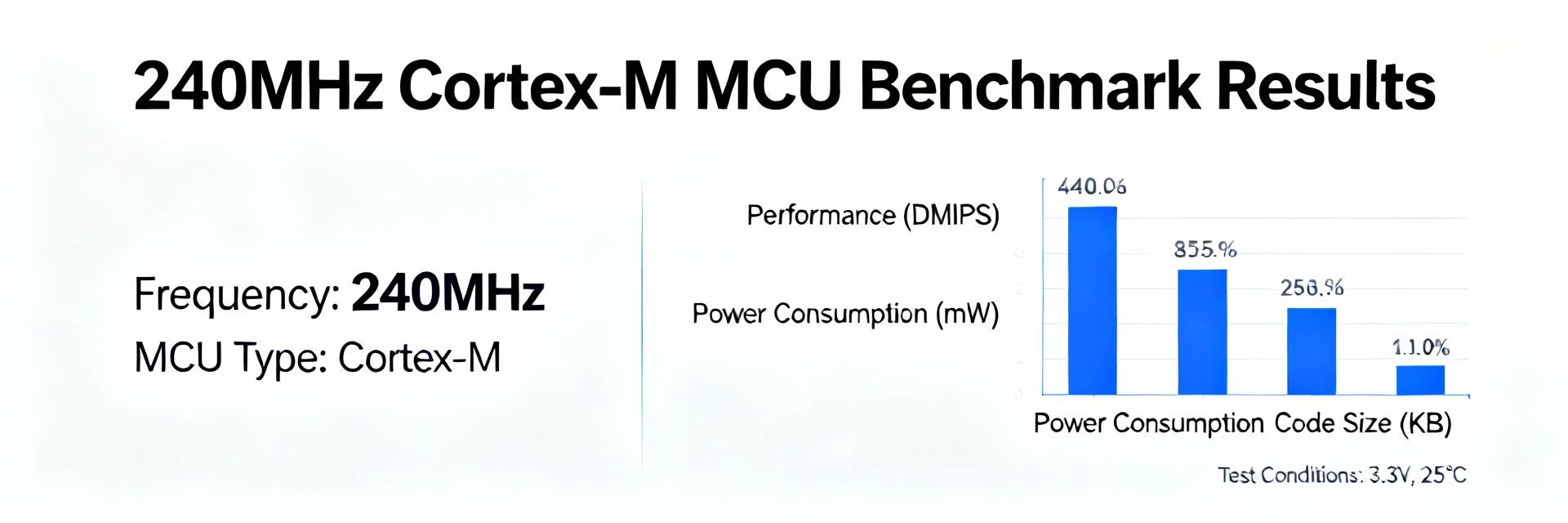
The intent is to provide clear MCU benchmarks, methodology, and actionable tuning guidance for embedded developers evaluating throughput, latency, and energy trade-offs.
01 Device background: what to expect from the GD32F470IKH6
Key specs that shape performance
Point: Expect a 240 MHz-class Cortex-M core with single-precision FPU and DSP extensions, multi-layer bus, and DMA fabric.
Evidence: High clock rate, FPU, and DSP blocks directly accelerate floating-point and signal operations.
Explanation: These features drive raw compute for control loops and signal chains, while DMA and peripheral count determine sustained I/O and system throughput.
Defining "performance" for this MCU
Point: Define a compact set of metrics you’ll measure.
Evidence: CoreMark/DMIPS for integer compute, single-precision FLOPS, and CMSIS-DSP cycles for signal work.
Explanation: These metrics separate compute-bound tasks (control, DSP) from I/O-bound tasks (sensor streaming) and frame expected system behavior.
Benchmarking methodology: testbed and reproducibility
Hardware and toolchain setup
Point: Use a deterministic test fixture and document every setting.
Evidence: Test board with external clock source, controlled power rails, and arm-none-eabi toolchain with explicit optimization flags.
Explanation: Reproducible results require a fixed clock, disabled dynamic clocks, and specified optimization flags (O2/O3/LTO) for repeatable measurements.
Benchmark suites and workload selection
Point: Choose suites that map to real workloads.
Evidence: CoreMark/Dhrystone for CPU, CMSIS-DSP FFT/FIR for signal path, and DMA transfer tests for I/O.
Explanation: This matrix maps microbenchmarks to application categories so results forecast system capability.
02 CPU & DSP results: raw compute and signal-processing benchmarks
Performance Throughput (Visualized)
Integer and floating-point throughput: Measure both integer and FPU paths and track compiler effects. Single-precision FPU yields significantly lower cycle counts on math-heavy kernels. O3 and link-time optimizations often improve throughput, but you must validate deterministic timing for real-time tasks.
DSP workloads (CMSIS-DSP): Quantify FFT and FIR cost per sample. CMSIS-DSP kernels reveal SIMD-friendly speedups and measured cycles-per-sample for 256/512 point FFTs. These numbers translate directly to maximum sustainable audio or sensor rates.
03 Memory, bus and peripheral throughput
Put time-critical code and buffers in the fastest memory regions and reserve flash for less-latency-sensitive code to maximize deterministic performance. Sizing DMA chunk sizes and aligning buffers reduces contention and sustains high throughput.
Power, thermal and real-world application scenarios
Power profiling under load
Capture power at idle, mid, and full streaming load. Power-meter traces during continuous DSP streaming demonstrate power-per-MHz trends and mode transition costs.
Application benchmarks
Closed-loop motor-control latency and IMU sensor-fusion update rates show achievable system rates. These tests map microbenchmarks to usable margins.
Optimization checklist and recommendations
- ✔ Compiler & Code: Apply targeted code optimizations; use FPU intrinsics and CMSIS-DSP routines to reduce cycles.
- ✔ System Tuning: Balance execution location (RAM vs Flash) and prioritize DMA channels for critical streams.
- ✔ Reliability: Document thermal/power margins and run pre-flight benchmarks to ensure stability under load.
Key Summary
- GD32F470IKH6 delivers strong single-precision compute and DSP capacity for 240 MHz-class tasks.
- DMA and careful buffer sizing sustain peripheral throughput; avoid CPU stalls by managing contention.
- Profile power versus performance trade-offs to meet energy budgets without compromising real-time requirements.
Frequently Asked Questions
