

A comprehensive analysis of single-core DSP/FPU performance for 240 MHz Cortex-M4-class designs, documenting test methodology, memory bandwidth, and optimization strategies.
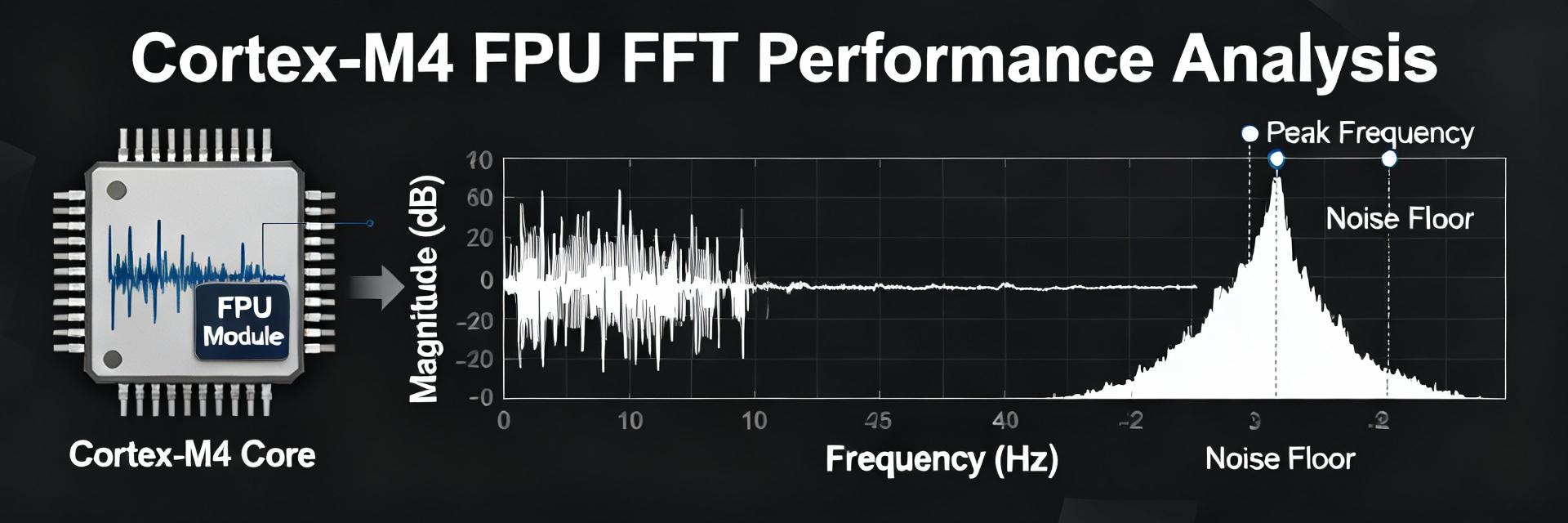
Background & Key Specifications Overview
Target Applications
The GD32F470ZIT6 is precision-engineered for real-time control, audio/voice DSP, and motor control. Its Cortex-M4 core with FPU/DSP extensions excels in deterministic control loops and multi-channel sensor aggregation.
Hardware Architecture
Equipped with a 240 MHz clock and configurable flash wait-states, the silicon defines high throughput via optimized AHB interconnect topology, directly influencing memory bandwidth and DMA latency.
| Specification | Typical Value | Strategic Significance |
|---|---|---|
| Core | 240 MHz Cortex-M4 + FPU | Raw single-core compute and floating-point throughput |
| Flash | Up to 1 MB, multi-bank | Execution speed, wait-state effect on latency |
| SRAM | 128–192 KB | Scratch and DMA buffering for memcpy/FFT operations |
| DMA | Multiple channels | Offloads CPU for sustained I/O performance |
Performance Metrics Visualization
CoreMark Efficiency (Higher is better)
92%
FPU FFT Throughput
88%
Performance Per Watt
85%
Deep Dive Analysis & Methodology
Benchmark Methodology & Testbed [+]
Tests utilize an evaluation board with 240 MHz PLL and controlled DC supply. Measurement involves high-resolution power meters to capture transient currents. The suite covers CoreMark for integer CPU, FPU FFT for floating throughput, and memcpy loops for memory bandwidth across different flash wait-state configurations.
Memory Subsystem & DMA Throughput [+]
Memory-bound workloads reveal that SRAM access patterns significantly outperform flash sourcing when nonzero wait-states are active. Utilizing the bus interconnect arbitration effectively allows DMA to sustain higher throughput with minimal CPU impact, crucial for real-time sensor fusion.
Comparative Analysis: GD32F470ZIT6 vs Peers [+]
Compared to other 200–300 MHz Cortex-M4 MCUs, this device often leads in FPU-heavy workloads. While memory bandwidth is competitive, the primary advantage lies in the DSP single-core performance-per-dollar ratio and the robust peripheral set integrated into the silicon.
Actionable Optimization Checklist
-
✓
Compiler Tuning: Enable FPU math intrinsics and use optimized DSP libraries to reduce cycle counts.
-
✓
Memory Mapping: Relocate critical hot code and data vectors to SRAM to bypass flash wait-state constraints.
-
✓
Peripheral Efficiency: Prefer DMA for bulk data transfers (SPI/SDIO) to keep CPU utilization in single digits.
-
✓
Hardware Integrity: Implement proper decoupling and thermal vias under the MCU to prevent frequency throttling.
