

1. Why SPI NOR Flash still matters in embedded BOMs
SPI NOR Flash remains the standard non-volatile memory for boot code, firmware, and FPGA bitstreams. Every microcontroller-based device you ship — from industrial IoT sensors to automotive ECUs — likely boots from a SPI NOR Flash chip. The three suppliers that dominate the independent distribution channel are Winbond W25Q (Taiwan), Macronix MX25L (Taiwan), and Micron MT25Q (USA). They use compatible JEDEC command sets, but their availability, pricing, and qualification posture differ sharply when you source outside authorized franchise — which is most of the time for small-batch, EOL, or shortage-driven procurement.
2. Quick comparison: W25Q vs MX25L vs MT25Q at a glance
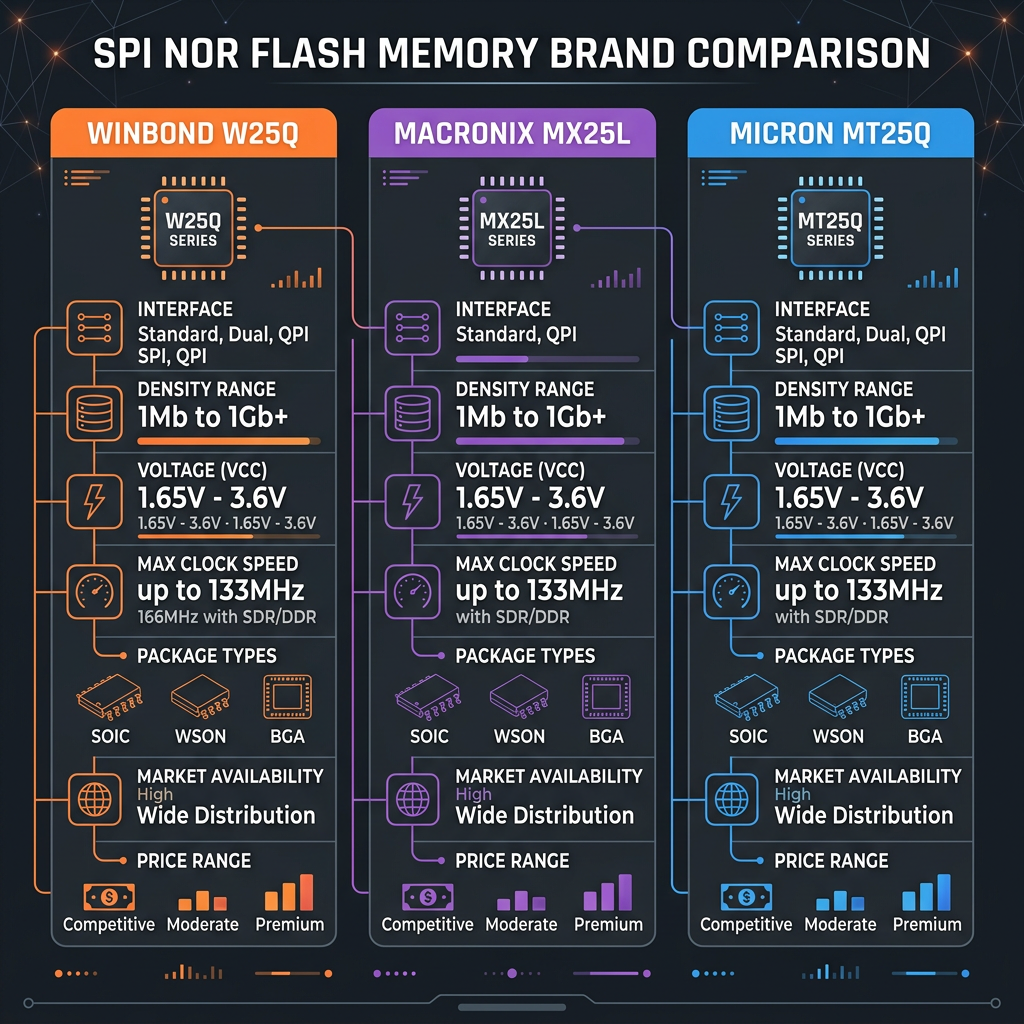
All three families support Single, Dual, and Quad SPI with densities from ~512 Kb to 512 Mb, 1.8 V and 3 V options, and industrial temperature range (-40 to +85 °C). The practical differences show up in the spot market:
• Winbond W25Q — Highest open-market availability and most competitive pricing. The W25Q16/W25Q64/W25Q128 densities are mass-produced and easy to source from HK/SZ stock. Quad clock up to 104 MHz. SOIC-8, WSON-8, USON-8 packages. Price roughly $0.15–$2.50 depending on density.
• Macronix MX25L — Solid silicon, but less widely stocked in the spot market. Good second-source option when Winbond is short. Quad clock up to 120 MHz. Price roughly $0.20–$3.00.
• Micron MT25Q — Strongest performance specs (133 MHz Quad SPI, XIP support) but highest price and variable lead time for specific density/package combos. Often the only choice for 256 Mb+ densities in WSON/BGA. Price roughly $0.30–$4.00.
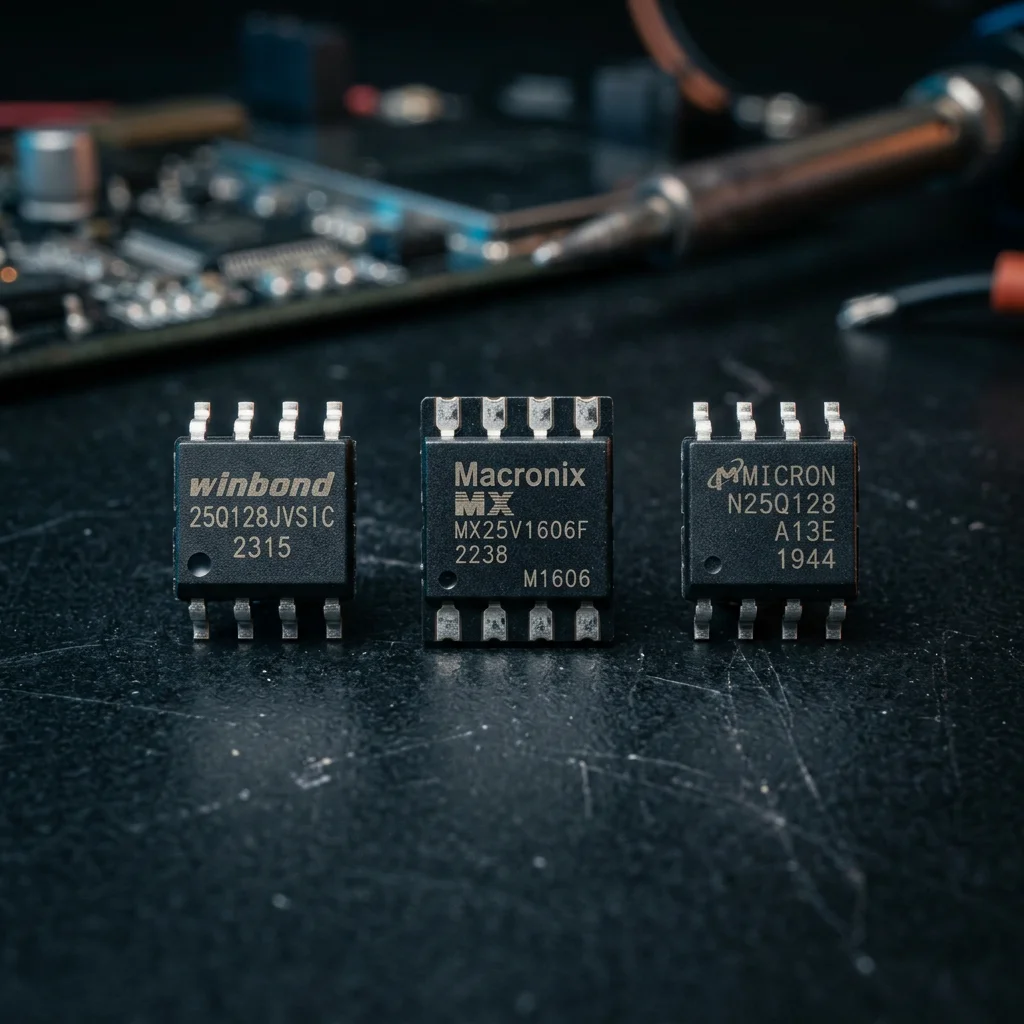
Open-market reality check: Winbond W25Q128 in SOIC-8 is easier to find in HK spot stock than Micron MT25QL128 in the same package. If your design can use either, specify both on the BOM as alternates and let your distributor quote whichever is faster and cheaper.
3. Density guide: which part for your use case
Don’t just replace the existing BOM line 1:1. Consider density headroom and market availability before locking in a PN.
16 Mb (2 MB) — Boot loader, small RTOS firmware
The sweet spot for MCU boot code. Winbond W25Q16JVSSIQ (3V, SOIC-8 208 mil) and Macronix MX25L1606EM2I-12G (3V, SOIC-8 200 mil) are the two most liquid PNs in this density. Heavily produced, easy to source, aggressively priced.
64 Mb (8 MB) — RTOS firmware, FPGA bitstream
Winbond W25Q64JVSSIQ (3V, SOIC-8 208 mil) is the default choice. Micron MT25QL128ABA in SOIC-16 covers this density as an alternative but is often overkill. Macronix MX25L6433FM2I is pin-compatible with Winbond in SOIC-8.
128 Mb (16 MB) — Linux boot, complex firmware
Winbond W25Q128JVEIQ (3V, WSON-8 8×6 mm) and Micron MT25QL128ABA1EW9-0SIT (3V, WSON-8 8×6 mm) are the two most common PNs at this density. Both are widely stocked in HK.
256 Mb – 512 Mb — Large firmware, data logging
Micron dominates here. MT25QL256ABA8ESF-0SIT (3V, SOIC-16 300 mil) and MT25QU512ABB1EW9-0SIT (1.8 V, WSON-8). These densities are niche and harder to source — expect longer lead times and higher pricing.
Example stocked lines: W25Q16JVSSIQ, W25Q128JVEIQ, MT25QL128ABA1EW9-0SIT, MX25L1606EM2I-12G — search iclee.com for your exact suffix.
4. How to select a SPI NOR Flash in 4 steps
This is the checklist we walk through with every RFQ:
Step 1 — Match the density (with headroom)
If your firmware is 12 MB today, pick a 128 Mb (16 MB) part, not a 128 Mb dual-die chip. Headroom prevents painful firmware re-architecture later. Bonus: 16 Mb and 128 Mb are massively overproduced densities — cheaper and easier to source than 256 Mb or 512 Mb.
Step 2 — Match the voltage
3V (2.7–3.6 V): Most common. All three brands carry 3V parts. 1.8 V (1.65–2.0 V): For low-power designs or MCUs running at 1.8 V rail. Micron MT25QU and Winbond W25QxxJW series. Fewer 1.8 V parts in spot stock — plan lead time accordingly.
Step 3 — Match the package footprint
SOIC-8 208 mil is the most universal. If your PCB uses WSON-8 or USON-8, your cross-reference options shrink — Micron may not offer all densities in those packages. Always verify the pad layout, not just the nominal package name.
Step 4 — Confirm temperature grade
Industrial (-40 to +85 °C): Suffix typically contains “I” — e.g., W25Q128JVEIQ. This is the default for embedded systems. Automotive (-40 to +105/+125 °C): Significantly more expensive and harder to source. Only pick this if your application truly requires AEC-Q100 qualification. Do not upgrade “just to be safe” — it can double your unit cost.
5. Winbond W25Q part number decoder
Winbond part numbers look cryptic until you break them down. Here is how to read W25Q128JVEIQ:
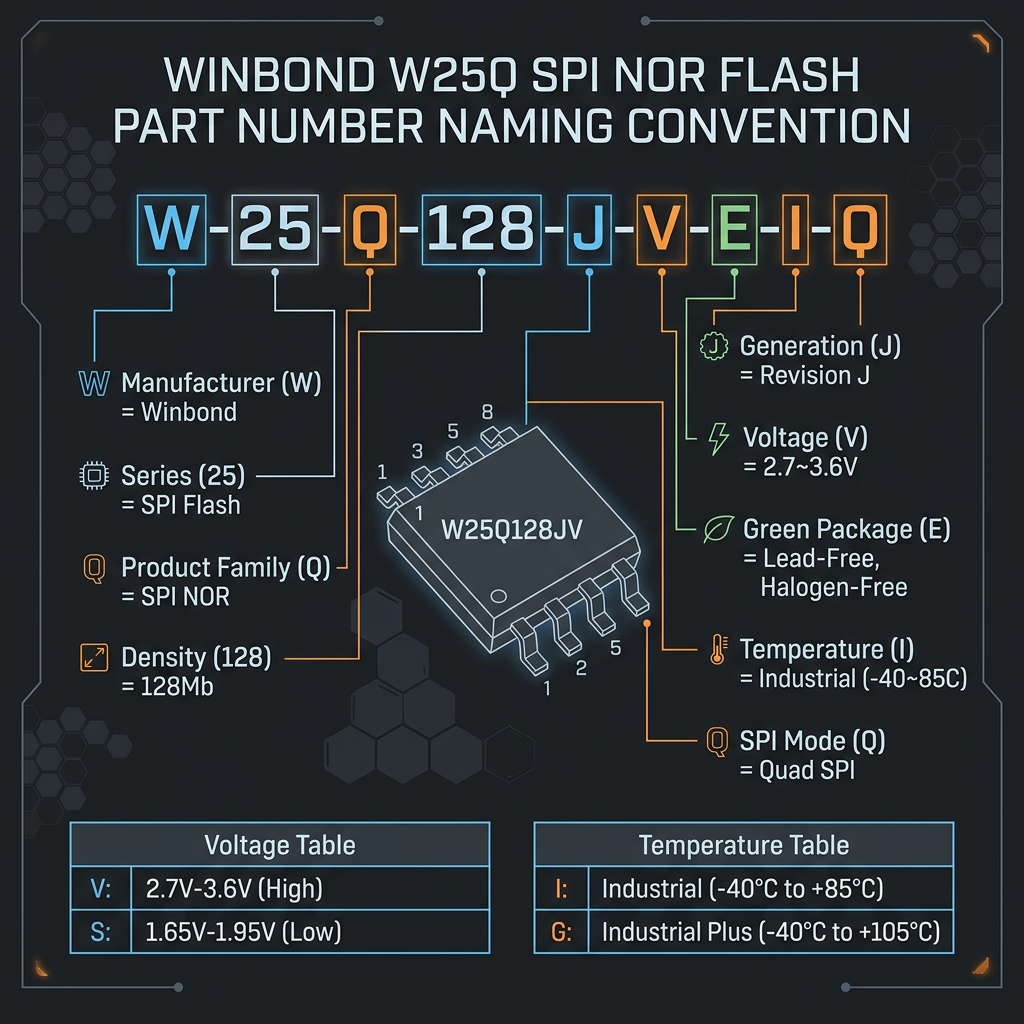
Below is the same breakdown in text — copy-paste into your BOM notes:
W  25  Q  128  J  V  E  I  Q
│  │   │  │    │  │  │  │  └── Quad SPI supported
│  │   │  │    │  │  │  └──── Industrial temp (-40~85°C)
│  │   │  │    │  │  └─────── Green package (Pb-free / Halogen-free)
│  │   │  │    │  └────────── Voltage: V=2.7~3.6V
│  │   │  │    └───────────── Generation (J is newer than F)
│  │   │  └────────────────── Density: 128 = 128 Mb
│  │   └───────────────────── Product family: Q = SPI NOR Flash
│  └───────────────────────── Series: 25 = SPI Flash
└────────────────────────────── Manufacturer: Winbond
Why this matters for sourcing: when you search for W25Q128JVSIQ but only find W25Q128JVEIQ, the difference is likely just the package — S = SOIC-8, E = WSON-8. The die is the same. If your PCB footprint accepts both, you just expanded your supply options meaningfully.
6. Cross-reference: can you swap W25Q ↔ MT25Q on the BOM?
Functionally yes, with caveats. Most 3V, 128 Mb, SOIC-8 SPI NOR Flash chips use the same JEDEC command set. In practice:
• Winbond W25Q128JVSIQ (SOIC-8) ↔ Micron MT25QL128ABA1EW9-0SIT (WSON-8) — needs pad-compatible layout
• Winbond W25Q64JVSSIQ ↔ Macronix MX25L6433FM2I — pin-compatible in SOIC-8
But always verify these three things before approving a cross:
1. Sector size — Winbond uses uniform 4 KB sectors; some older Macronix parts default to 64 KB block erase. Your flash driver must handle both erase sizes.
2. QE bit (Quad Enable) — Winbond sets QE in Status Register-2; Micron uses a non-volatile configuration register. Your bootloader must issue the correct command sequence for each brand.
3. WP# pin behavior — Write-protect pin logic differs slightly between brands. Test on a real board, not just the datasheet.
7. Source SPI NOR Flash at IClee — open-market without the guesswork
We carry Winbond W25Q, Macronix MX25L, and Micron MT25Q series in our Hong Kong and Shenzhen warehouses. Every incoming lot passes IQC visual inspection, X-ray sampling on BGA/WSON packages, and functional socket test for memory ICs. We do not list anonymous inventory — every PN is traceable to a physical lot in HK or SZ.
Send PN (with full suffix) + qty + target date code. We reply with HK/SZ stock status, MOQ, price, and ship path in ~24 business hours. Cross-reference requests welcome — include both your original PN and the alternate you want us to check.
New to sourcing memory ICs through independent distribution? See our Quality Control page for IQC/X-ray procedures, or How Independent Distributors Verify Electronic Components for the full verification framework.
SPI NOR Flash on your BOM?
HK/SZ stock check · small batch OK · IQC + X-ray on request · ~24h quote on BOM lines
WhatsApp Submit RFQ